Students Experiencing Foster Care Deserve Stability. Charlotte Should Protect It.

Charlotte Center for Legal Advocacy’s Education Law Program: Caitlin Whalan Jones, Daniel Brown, Stephanie R. Klitsch

We believe that students experiencing foster care deserve access to the same quality education as their peers. This is an uncontroversial opinion; one you probably agree with and is even supported by federal law. Unfortunately, students experiencing foster care are far more likely to face school disruption, enrollment delays, and lost academic progress because the systems designed to support them are complex and fragmented. Moreover, many school districts across the state struggle to comply with basic federal requirements for students experiencing foster care.

Charlotte chose a different path. Many years ago, Charlotte‑Mecklenburg Schools (CMS) and Mecklenburg County Department of Social Services (DSS) created a unique and powerful model of collaboration, embodied through four CMS-DSS Educational Liaisons. So, it was a shock to learn of the proposal to eliminate these positions after June 2026, which would unravel years of progress.

The Liaisons are a small but vital team that works to ensure students experiencing foster care have access to the education they deserve and are entitled to under the law. The Liaisons actively bridge the vast gap between CMS and DSS, doing the daily work needed to keep students from falling in. Unless you know a student experiencing foster care, or were one yourself, you might have never heard of the Liaisons. But, for folks with that lived experience, the importance of the Liaisons cannot be overstated, and their loss would be deeply felt.

The educational journey for students experiencing foster care is often littered with obstacles. Frequent school changes, delays in arranging transportation, and incomplete records are just a few of the more common ones. Consequently, and through no fault of their own, these students are more likely to perform below grade-level, be retained, or drop out of school altogether. In 2025, across North Carolina, only 60% of students experiencing foster care graduated from high school within four years. Within CMS, however, the four-year graduation rate lagged at just 46%. The work of the Liaisons is to try and clear those obstacles and, hopefully, help students meaningfully access their education.

Federal law makes clear that ensuring educational stability for students experiencing foster care is not the responsibility of school districts alone, nor of child welfare agencies acting in isolation, but a shared obligation that requires close and continuous partnership. These obligations cannot be met through informal coordination. They require dedicated roles with the time, expertise, and authority to bridge systems. In Mecklenburg County, the Liaisons have fulfilled this role.

For many years, CMS and the County shared the cost of this joint work, with each entity contributing funding in recognition of their shared legal obligations and mutual interest in educational stability for students experiencing foster care. The Liaisons themselves, however, remained CMS employees throughout that time.

Understanding this history matters, because it underscores an essential point: CMS and DSS deliberately built this model as a joint solution to a joint responsibility. Their work is embedded within CMS operations, supporting more than 100 schools while coordinating with DSS, courts, health providers, and community partners.

The question before our community is not whether CMS and DSS will continue serving students in foster care. The law requires that they do. The question is whether Charlotte will continue doing so in a way that is coordinated, proven, and centered on student stability, or whether it will disperse specialized work without a clear plan and with hope the pieces reassemble themselves.

For almost three decades, CMS‑DSS Educational Liaisons have provided continuity, expertise, and accountability for students whose lives are already marked by change. Charlotte has been doing this right. We should take care not to lose ground on one of the most effective partnerships our community has built, especially when students experiencing foster care cannot afford the cost of disruption.

Charlotte Center for Legal Advocacy is a nonprofit law firm that provides civil legal services to low-income individuals and families across the Charlotte region and North Carolina. The Education Law Program (ELP) advocates on behalf of students, including students experiencing foster care, who are facing a range of obstacles to the realization of their fundamental education rights. ELP co-leads the Mecklenburg County Foster Care and Education Work Group which includes judicial, education, and child welfare stakeholders and aims to improve educational outcomes for students experiencing foster care.

Summer 2026 Internships at Charlotte Center for Legal Advocacy – Apply by Oct. 24

The Charlotte Center for Legal Advocacy offers 10-week internships to qualified and motivated undergraduate and law school students. We strive to provide an intensive, practical, and worthwhile internship for students who are passionate about providing legal services to low-income people in Mecklenburg County and beyond.  

Our interns work directly with staff attorneys on their caseloads handling tasks that range from drafting documents for administrative matters, providing direct client services, and participating in systemic advocacy projects. Law student work may include interviewing clients and witnesses; collecting, evaluating, and preparing evidence for presentation; performing legal research; drafting pleadings, briefs and other legal documents; and advocating for clients before administrative agencies. 

Submission Deadline: October 24, 2025
Summer Session: May 26 – July 31, 2026

Internship opportunities for law students in each of the following units.  

Internship opportunities for undergraduate students in the following units:  

Schedule: Advocacy Center staff enjoy a hybrid work schedule. Interns are required to be present in the office 3 days per week and may work remotely for the remaining 2 days. Interns are expected to work 7.5 hours per day between the hours of 8:30am and 5pm. Time off and other details of working hours are between the intern and their supervisor. 

Funding: The Advocacy Center is unable to offer compensation to interns. We encourage students to apply for public interest stipends or work-study grants through their school or other institutions if they are unable to work on a volunteer basis. In the past, most interns have been able to secure outside funding to cover living expenses. Advocacy Center staff will provide any supporting documentation and letters of recommendation necessary to obtain funding for selected applicants.  

To Apply

  • Send the following to internship@charlottelegaladvocacy.org:
    • Cover letter 
    • Résumé or curriculum vitae 
    • An unofficial academic transcript  
    • Any other information you wish to include  
  • Inquire about financial support, internship, or externship programs available through your school or other institutions. 

Submission Deadline: October 24, 2025
Interviews: November 3-14, 2025

Charlotte Center for Legal Advocacy is an equal opportunity employer. Women, minorities, veterans, and people living with disabilities are encouraged to apply.

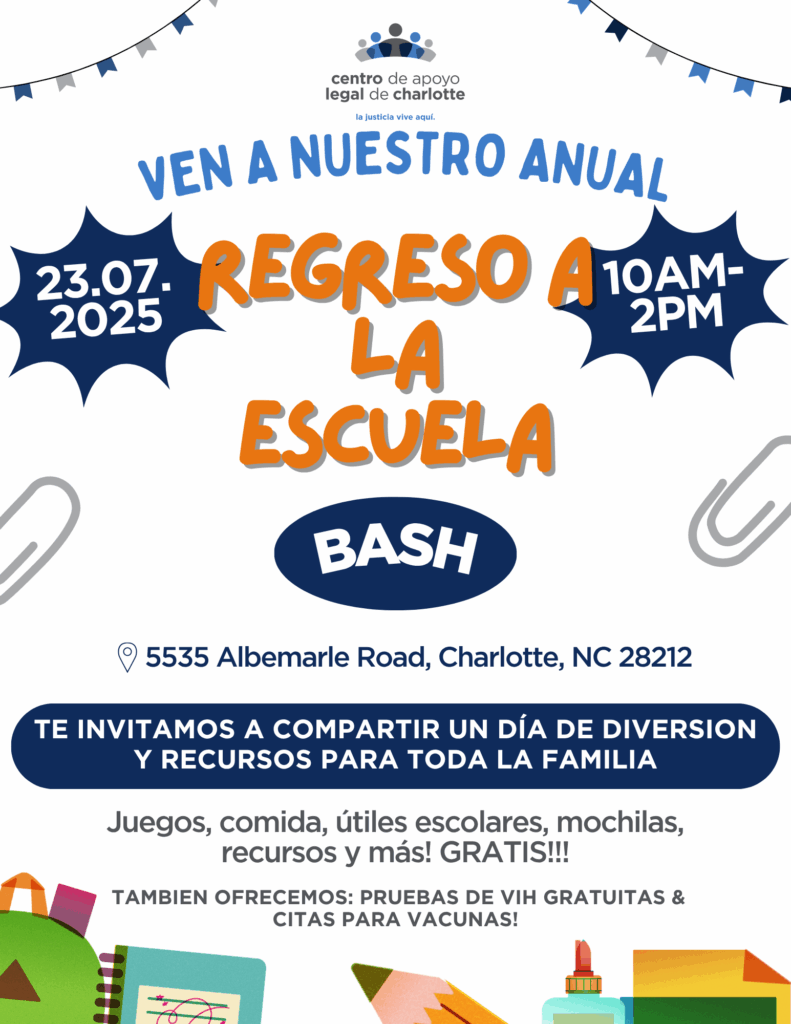
Mark Your Calendar: Back to School Bash Set for July 23

Charlotte Center for Legal Advocacy will host its annual Back to School Bash on Wednesday, July 23, from 10 a.m. to 2 p.m. at its office at 5535 Albemarle Road.

This FREE, family-friendly event is an opportunity for children and families to celebrate the season, connect with community resources, and prepare for a strong start to the school year.

Attendees can enjoy:

  • Connecting with community resources
  • FREE food, games and activities
  • FREE backpacks and school supplies

Charlotte Center For Legal Advocacy Names New CEO

For Immediate Release: April 24, 2025

Kelly Lynn, Charlotte Center for Legal Advocacy, 980.202.7320, kelly.lynn@charlottelegaladvocacy.org

Charlotte, NC – Charlotte Center for Legal Advocacy (Advocacy Center), a nonprofit civil legal services organization committed to pursuing justice for those in need, is pleased to announce the appointment of Larissa Mañón Mervin as its new Chief Executive Officer. Mañón Mervin will officially assume the role on May 27, 2025.

Larissa Mañón Mervin brings a deep commitment to legal equity and a wealth of experience to the Advocacy Center. She currently serves as the Regional Managing Attorney of Legal Aid of North Carolina’s Piedmont region, where she oversees the Charlotte, Concord and Gastonia offices. She also serves as the Managing Attorney for the Charlotte office, where she manages the Charlotte office’s operations, personnel and case work in a variety of practice areas, including landlord-tenant, domestic violence, family and consumer law. Prior to serving as Regional Managing Attorney, Mañón Mervin worked in various roles at Legal Aid of North Carolina, including as supervising attorney with their statewide Pro Bono Program, supervising attorney with the Domestic Violence Unit at Legal Aid – Charlotte, and as a domestic violence staff attorney in the Concord, Raleigh and Durham offices. In those roles, Mañón Mervin primarily represented survivors of domestic violence, sexual assault and child abuse in their civil protection order cases. Throughout her career, Mañón Mervin has been a tireless advocate for marginalized populations, continually working to ensure access to justice and fairness in civil legal matters.

Mañón Mervin received her Bachelor of Arts degree, summa cum laude, from the University of North Carolina at Greensboro and her Juris Doctorate, cum laude, from Quinnipiac University School of Law. She completed her legal studies as a visiting student at the University of North Carolina School of Law after moving back to North Carolina, and she successfully completed an executive management leadership program at Harvard Business School last year.

Mañón Mervin serves on various boards and bar associations, including the American Bar Association, North Carolina Bar Association, Cabarrus County Bar Association, and Mecklenburg Bar Association. She has received numerous awards for her work and commitment to justice, including the Charlotte Business Journal’s 40 under 40, North Carolina Lawyers Weekly and The Mecklenburg Times’ 50 Most Influential Women, the Power 100 awarded by the Congressional Black Caucus Foundation, National Bar Association and Washington Bar Association, and the Ronda F. Williams Professionalism Award.

“I am incredibly grateful for the opportunity to lead the Advocacy Center at such a pivotal time in our community’s history,” said Mañón Mervin. “Access to justice is vital in protecting the rights of our most vulnerable neighbors. Using the rule of law to ensure safety and stability to those in need is the responsible, wise and compassionate thing to do. It is what the advocates at the Advocacy Center do every day, and I’m excited to join such a dedicated group of professionals in this righteous and necessary work.”

The Board of Directors expresses deep appreciation for Kara Moskowitz, who has served as Interim CEO for the past year, as well as Cassidy Estes-Rogers, who has served as the Interim COO, each of whom guided the organization through a time of transition with grace and dedication.

“We are thrilled to welcome Larissa Mañón Mervin to the Advocacy Center,” said Ed O’Keefe, Chairperson of the Board of Trustees for Charlotte Center for Legal Advocacy. “Her strategic vision, legal expertise and passion for justice make her the right leader to guide us forward. We are equally grateful to Kara Moskowitz and Cassidy Estes-Rogers for their steady leadership during the interim period.”

The Charlotte Center for Legal Advocacy provides legal services in areas such as health care access, immigration, consumer protection, public benefits, tax clinics and more. With Mañón Mervin at the helm, the organization looks forward to deepening its impact and continuing its fight for equal justice under the law.

About Charlotte Center for Legal Advocacy

Charlotte Center for Legal Advocacy can provide those in need with information, advice and advocacy in consumer protection, home preservation, health care access and public benefits, immigration, tax assistance and more. Our mission is to pursue justice for those in need. Our vision is to build a just community, where all people are treated fairly and have access to legal representation to meet their basic human needs of safety, economic security and stability. Learn more at charlottelegaladvocacy.org.

2024 Annual Report: A Year of Advocacy and Impact

In FY 2024, Charlotte Center for Legal Advocacy served 11,774 individuals across our community.

One of them was Renai (pictured second from the right with her sister and their grandchildren). When Renai faced the threat of losing her home to an unexpected lien, she turned to the Advocacy Center for help. With support from our advocates, Renai navigated complex legal proceedings and committed to a five-year repayment plan to save the house where her mother—Big Mama—raised their family. A home filled with generations of memories and milestones. In October 2024, Renai made her final payment, ensuring her family’s home—and Big Mama’s legacy—remains a place of love and community for generations to come.

Explore more of the stories, the numbers, and the people who shaped our year:

Advocacy Center Health Insurance Navigators Recognized With Consortium Member Impact Award

This week, we had the privilege of joining the NC Navigator Consortium, alongside community partners and advocates, to celebrate two incredible milestones: 15 years of the Affordable Care Act (ACA) and more than 640,000 North Carolinians enrolling in Medicaid Expansion. These achievements mark significant progress in expanding access to quality, affordable health coverage across our state.

At the event, we were honored to receive the Consortium Member Impact Award from the NC Navigator Consortium. This award recognizes our Health Insurance Navigator‘s outstanding achievements in promoting public health by advancing Affordable Care Act and Medicaid enrollment across North Carolina.

Need Health Insurance? We Can Help!

If you have questions about Medicaid eligibility or Marketplace enrollment, our Health Insurance Navigators are here to guide you through the process—for free!

Schedule an appointment with a local Navigator:
📞 980-256-3782
🌐 ncnavigator.org

Termination of Unaccompanied Kids Program Affects Charlotte Center for Legal Advocacy

For Immediate Release: March 25, 2025                        
Kelly Lynn, Charlotte Center for Legal Advocacy, 980.202.7320, kelly.lynn@charlottelegaladvocacy.org  

Charlotte, NC – Immigration children will be forced to navigate the legal system alone, due to the U.S. Department of Health and Human Services terminating nearly all of the legal work by the Acacia Center for Legal Justice (Acacia). Charlotte Center for Legal Advocacy (Advocacy Center) was set to receive $900,000 in annual funding from Acacia in a contract renewing on April 1. The majority of this contract was cancelled on March 21, effective immediately.

Acacia contracts with the government to provide legal services through its network of providers around the country to unaccompanied migrant children under 18, both by providing direct legal representation as well as conducting legal orientations — often referred to as “know your rights” clinics — to migrant children who cross the border alone and are in federal government shelters. The Advocacy Center can still provide “know your rights” clinics but can no longer represent children when they go to immigration court.

Kara Moskowitz, Interim Chief Executive Officer of the Charlotte Center for Legal Advocacy, emphasized the devastating impact of this decision. “Charlotte Center for Legal Advocacy currently has more than 300 active cases affected by this funding cut, impacting children who have suffered abuse, neglect, abandonment or other forms of harm. Without legal representation, these vulnerable children face insurmountable barriers to securing safety and stability. Terminating the Unaccompanied Children Program will leave hundreds of children defenseless in a complex legal system that was never designed for them to navigate alone. This decision is not just a bureaucratic shift—it is a direct attack on children’s rights and well-being.”

The Advocacy Center’s Immigrant Justice Program serves immigrant children and their families experiencing dire situations including human trafficking, domestic abuse and discrimination. Most of the children we are serving have suffered abandonment/abuse/neglect/gang activity, and they had to flee abusive and terrible conditions in their home countries where they were not being properly cared for. The vast majority of the children are coming to the United States alone or are being brought in by family members/friends/coyotes to help them escape their personal situations in their home countries.  

The majority of our clients range from a few months old to 17 years old.  It is virtually impossible for a child to understand their legal options or successfully navigate complex legal proceedings alone, without a specialized children’s rights attorney.  According to the Congressional Research Service in 2021, attorneys have a dramatic impact on children’s cases; immigration judges were almost 100 times more likely to grant legal relief to unaccompanied children with counsel than to those without.

About Charlotte Center for Legal Advocacy

Charlotte Center for Legal Advocacy can provide those in need with information, advice and advocacy in consumer protection, home preservation, health care access and public benefits, immigration, tax assistance and more. Our mission is to pursue justice for those in need. Our vision is to build a just community, where all people are treated fairly and have access to legal representation to meet their basic human needs of safety, economic security and stability. Learn more at charlottelegaladvocacy.org.

Struggling with Property Taxes? Free help is Available for Eligible Homeowners

With property values soaring across North Carolina, many homeowners are finding it increasingly difficult to keep up with their housing costs, including property taxes. However, relief is available for eligible residents. North Carolina offers property tax assistance to low-income elderly, disabled individuals, and disabled veterans. If you qualify, you could receive a significant reduction in your property tax burden—but you must apply before June 1, 2025.

Need Help Applying?

Charlotte Center for Legal Advocacy is here to help. Our team can assist low-income elderly, disabled individuals, and disabled veterans in preparing their North Carolina property tax relief applications. Call 980-256-7952 to learn more about eligibility for our services.

Additionally, you can attend our property tax clinic for in-person assistance:

Date: April 16, 2025
Location: Charlotte Center for Legal Advocacy, 5535 Albemarle Road, Charlotte, NC 28212
Time: 9:30 a.m. – 1:00 p.m.
Register: Call 980-256-7952 to schedule an appointment.

Who is Eligible for Property Tax Relief?

If you are a qualifying homeowner, you may be eligible for an exclusion of either $25,000 or 50% of your home’s taxable value (whichever is greater). To qualify, you must meet the following requirements:

  • Your name must be on the deed or title of your residence as of January 1, 2024.
  • The home must be your primary residence.
  • You must be a North Carolina resident.
  • You must be at least 65 years old or totally and permanently disabled. (A total and permanent disability means a condition that prevents you from obtaining gainful employment.)
  • Your household income (including your spouse’s) must be $37,900 or less for 2024.

Special Property Tax Relief for Disabled Veterans

Disabled veterans in Mecklenburg County may qualify for an additional property tax benefit. If eligible, they may receive an exclusion of the first $45,000 of their home’s taxable value. To qualify:

  • The veteran must have received an honorable discharge.
  • The home must be occupied by the disabled veteran.
  • The veteran must be 100% totally and permanently disabled due to a service-connected injury.
  • Surviving spouses (who have not remarried) of qualifying disabled veterans may also be eligible.
  • There is no age or income limitation for this exemption.

How and When to Apply

Applications must be submitted to the Assessor’s Office between January 1st and June 1st, 2025.

Winter Tax Talk Series: Navigate Tax Season with Confidence

Join us this winter for our community Tax Talks Series, hosted by the Charlotte Center for Legal Advocacy’s North Carolina Low-Income Taxpayer Clinic! These sessions are designed to help you navigate various tax topics with confidence. Here’s what we have planned:

TAX TALKS

Participate in the following tax talks in-person at the Advocacy Center or tune in to the Facebook Live on the Advocacy Center Facebook page.

Self-Employment Basics

This tax talk was on Nov. 7. Not able to attend? Click here to view this tax talk and click here to view the slides for this session.

If you’re an independent contractor, small business owner, or otherwise self-employed, this Tax Talk is for you! Topics covered at this tax talk will include:

  • Recordkeeping
  • Quarterly estimated tax payments

Reminders for Tax Season

This tax talk was on Dec. 5. Not able to attend? Click here to view this tax talk and click here to view the slides for this session.

This Tax Talk will cover essential tips and reminders for the upcoming tax season, including:

  • How to avoid tax scams
  • Filing requirements you need to know
  • Free resources for filing your taxes

Tax Topics for Immigrants

This tax talk was on Jan. 15. Not able to attend? Click here to view this tax talk and click here to view the slides for this session.

In this session, we’ll cover topics relevant to immigrant taxpayers, including:

  • ITINs vs. SSNs and how to merge the two
  • Eligibility for tax credits

CHARLAS SOBRE IMPUESTOS

Conceptos Básicos del Trabajo por Cuenta Propia (6 de noviembre de 2024)

Haga clic aquí para ver la presentación.

Recordatorios para la Temporada de Impuestos (4 de diciembre de 2024)

Haga clic aquí para ver la presentación.

Temas Impuestos para Inmigrantes (15 de enero de 2025)

Haga clic aquí para ver la presentación.

Free Community Tax Talk: Tax Topics for Immigrants

With tax season around the corner, Charlotte Center for Legal Advocacy’s North Carolina Low-Income Taxpayer Clinic (Tax Clinic) is hosting a free community Winter Tax Talks series to help equip attendees with the knowledge and resources they need to navigate tax season with confidence. 

The next community tax talks will be held on Jan. 15 and 16 and will cover tax topics for immigrants. 

Topics covered will include: 

  • ITINs vs. SSNs and how to merge the two
  • Eligibility for tax credits

Event Details:

  • January 15 (in Spanish): 6 p.m. via Facebook Live on the Advocacy Center’s page 
  • January 16 (in English): 6 p.m. in-person (5535 Albemarle Road, Charlotte) and via Facebook Live on the Advocacy Center’s page 

This year, the Tax Clinic has delivered presentations and created a number of resources to help inform North Carolinians about various tax-related topics, including reminders for tax seasonself-employment taxes and understanding the tax implications of online sports betting

The North Carolina Low-Income Taxpayer Clinic, a program of Charlotte Center for Legal Advocacy, provides free representation for low-income taxpayers in federal and state tax disputes while educating individuals about their rights and responsibilities as U.S. taxpayers. 

Charlotte Center for Legal Advocacy provides those in need with information, advice and advocacy in consumer protection, home preservation, health care access and public benefits, immigration, tax assistance and more. Our mission is to pursue justice for those in need. Our vision is to build a just community, where all people are treated fairly and have access to legal representation to meet their basic human needs of safety, economic security and stability. Learn more: charlottelegaladvocacy.org