Action Alert: “Show Me Your Papers” Bill Threatens Community Safety

Yesterday, the N.C. House approved a bill that strips local authority from sheriffs’ departments by requiring them to cooperate with Immigration and Customs Enforcement (ICE) and assist in enforcing federal immigration law.

The legislation now goes before Gov. Roy Cooper for consideration after the N.C. Senate passed the bill in June.

House Bill 370, the “Show Me Your Papers” law, would require all N.C. sheriffs and jails to comply with immigration detainer requests made by the U.S. Department of Homeland Security, even though these detainer requests are not considered valid warrants, which means sheriffs should have full discretion within their local authority to not recognize them.

The bill also requires police to determine the immigration status of any person arrested for a criminal charge and to notify ICE if the person is not a legal resident or citizen and forces jails to wait for federal approval before releasing an individual being held, even if the person is eligible for release under North Carolina law.

It would allow anyone to sue their local government if they believe it is not cooperating with immigration enforcement activities or breaking state law related to immigration.

HB370 is a direct response to local sheriffs across North Carolina, including Mecklenburg County Sheriff Gary McFadden, choosing to end federal 287(g) programs in their counties, which ended the requirement of local law enforcement to cooperate with and assist ICE in detaining undocumented residents.

Mecklenburg County participated in 287(g) for 12 years. During that time, the program diverted our local public safety resources away from protecting our community toward carrying out federal immigration enforcement policies.

Instead of addressing and preventing violent crime, the program incentivized local law enforcement officials to actively seek out undocumented residents with no criminal history through procedures that border on racial profiling and erode trust in the immigrant community.

Mecklenburg County Sherriff Gary McFadden was elected to office on a wave of local support for ending the 287(g) program.

Now the N.C. General Assembly is trying to override the will of Mecklenburg County voters to assert its own control over how our local law enforcement officials do their jobs.

Is this the best use of tax-payer dollars to keep our community safe? We don’t think so.

Charlotte Center for Legal Advocacy believes this bill is a detriment to community safety, local autonomy and family unity for all Mecklenburg County residents.

We urge Governor Roy Cooper to veto this legislation.

287(g) facilitated thousands of deportations by arresting individuals for minor traffic infractions or misdemeanors. This practice has torn families apart, made immigrants vulnerable targets for exploitation and eroded the trust of law enforcement in the immigrant community.

None of these ramifications made our community safer and neither does a systematic dragnet that targets communities of color. Instead, it forces people to withdraw from their communities, from working, attending school, seeking medical care and reporting crime out of fear.

Charlotte Center for Legal Advocacy continues to stand with our immigrant neighbors, advocating for inclusion and fairness under the law to ensure their safety, security and stability in our community.

What you can do

Contact Gov. Roy Cooper’s office by phone
(919) 814-2000 or email or sign this petition to express your concern for HB370 and call on him to veto the legislation.

Our community deserves safety, local autonomy and protected family unity.
Sign up to have our Action Alerts delivered straight to your inbox!

Legal Groups Urge Lake Arbor Residents to Seek Legal Advice

Concerns of residents signing away tenant rights

Charlotte, NC – Local legal advocacy groups are urging residents at Lake Arbor Apartments to seek legal advice before signing any document from the apartment community.

On July 30, residents received a notice from Lake Arbor Apartments stating that they must move out by December 31, while some were told they had leases that had expired or were no longer valid. Those residents were told they have only 30 days to move out, until the end of August. The notice also informed residents of an “Incentive Package” available for those who choose to leave voluntarily.

Charlotte Center for Legal Advocacy and the North Carolina Justice Center are concerned that residents could be giving up their legal rights as tenants without fully understanding all their options. The organizations urge Lake Arbor residents to speak to an attorney before they decide whether to sign anything.

Lake Arbor residents who have been told to move out, asked to sign a release or offered an Incentive Package from the rental company should call 919-856-2169 to receive free legal advice and discuss their options with an attorney from these organizations.

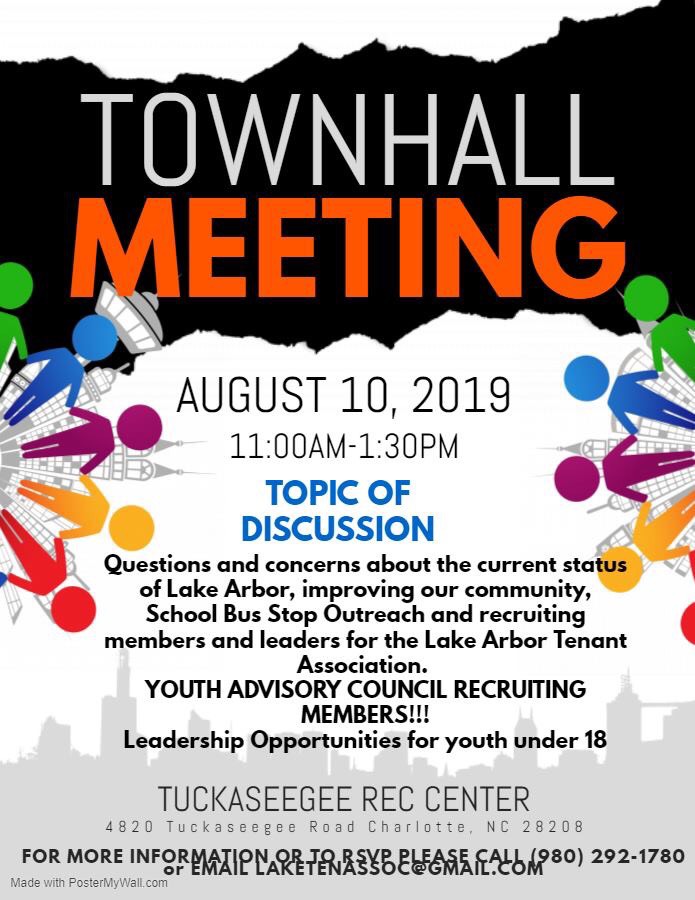
Lake Arbor Community Town Hall

Saturday, August 10, 2019 | 11 a.m. to 1:30 p.m.
Tuckaseegee Rec Center
4820 Tuckaseegee Road
Charlotte, NC 28208
For more information or RSVP: 980-292-1780 | laketenassoc@gmail.com

The North Carolina Justice Center is one of the state’s preeminent voices for economic and social justice. As a leading progressive research and advocacy organization, its mission is to eliminate poverty in North Carolina by ensuring that every household in the state has access to the resources, services, and fair treatment it needs to achieve economic security.

Charlotte Center for Legal Advocacy (formerly Legal Services of Southern Piedmont) provides expert legal advice and representation to those who cannot afford it, but desperately need it, something the organization has been doing since its inception in 1967. The Advocacy Center serves more than 3,500 families each year who are facing a crisis of safety, shelter, health or income, while providing committed advocacy work toward policy changes at the local and national level to impact a greater number of people. Charlotte Center for Legal Advocacy is a champion for those in need, ensuring their safety, security and stability.

Beneficiarios de Medicaid tendrán que elegir un proveedor privado


Charlotte N.C. – La División de Beneficios de Salud del Estado dio a conocer la afiliación del Medicaid de Carolina del Norte y NC Health Choice, con planes de salud privado, cambio que en la región del Condado de Mecklenburg, Cabarrus y Union, tomará efecto en octubre del 2019.


“Ahora las personas que están inscritas en Medicaid deben elegir un plan de salud y recibir todos sus beneficios a partir de ese plan de seguro privado”, explicó Johanna Parra, Paralegal del Centro de Apoyo Legal de Charlotte, organización que cuenta con el Departamento de Asesoría para beneficiaros de Medicaid y Medicare que creen sus derechos han sido violados.

Leer más a holanews.com.

Thoughts on Tax Advocate Nina Olson

Senior attorney Soreé Finley recently reflected on her first interaction with National Taxpayer Advocate Nina Olson, who retires today after a long career of fighting for fair tax policies for all Americans. This blog post originally appeared in Procedurally Taxing.

I can’t remember the exact year of my first Low-Income Taxpayer Clinic (LITC) conference. I do however remember the elevator ride to the Hilton’s meeting rooms: There are several attendees on the elevator, all hoping to be seated by 8:30 a.m. I am a new attorney and I want to impress my LITC director with my timeliness, but I’m struggling with the early start time.

I walk into this big meeting room, and there’s a nervous and excited energy among the attendants. I’m nervous too, of course—it’s my first legal conference, and I’m in a room full of attorneys. As I look for my table, I keep hearing the word “N.I.N.A.”, and figure it’s one more IRS acronym I’ll have to learn.

I sit at my table as my watch displays “8:30.” Someone approaches the podium and the room goes silent. It’s Nina—not N.I.N.A.—Olson, the National Taxpayer Advocate. For the first time, but not the last, I am blown away by her profound and contagious commitment to taxpayer advocacy.

Years after my first introduction to Ms. Olson, I am still inspired by her courage and willingness to ensure taxpayers and tax practitioners have a positive and consistent experience when interfacing with the IRS. There are millions of taxpayers who may never know Nina Olson’s name, but her legacy and impact on taxpayer advocacy will continue long after she retires.

Thousands of immigrants seek asylum in Charlotte court. Nearly all will lose.

Charlotte N.C.- “Stand up and raise your right hand,” Judge William Riggs said.

He looks expectantly at a Central American man in front of him, who’s wearing headphones to listen to the Spanish interpreter to the left of Riggs. Before she finishes translating, Riggs raises his own right hand to demonstrate the action.

After the man takes an oath, a baby, in the wooden benches designated for observers, starts whining. The mother bounces her knees up and down, attempting to soothe the child.

The immigrant’s lawyer explains his claim, and at one point, Riggs rests his chin in his hand.

It’s about 9 a.m., and this is the first of dozens of asylum cases he’ll hear that day. Once the lawyers finish, he either assigns a later individual hearing or orders the respondent removed from the country.

All of this takes place in Charlotte’s immigration court, located in a mundane office building in east Charlotte. There isn’t a sign outside to identify it, and once inside, you have to take a rickety elevator to the fourth floor — just three floors above an immigration law firm.

That’s where anyone in the Carolinas has to go to claim asylum, and its four judges are some of the strictest in the country.


Read more at charlotteobserver.com

Ofrecen protección al contribuyente

Charlotte N.C.- El Servicio y Defensa al Contribuyente en colaboración con el Centro de Apoyo Legal de Charlotte llevarán a cabo el lunes 15 de julio un taller informativo sobre la resolución de problemas de impuestos.

El taller que será impartido en español, está dirigido a contribuyentes que tiene algún caso existente con el Servicio de Rentas Internas, IRS, ya sea de colección o acuerdo de pagos, auditorias, apelaciones, robo de identidad, que necesiten representación en la corte de impuestos o tengan preguntas sobre su devolución de impuestos, de individuales o negocios.

Leer más a holanews.com

Advocacy Center Assisting Tax Fraud Victims in Local Case

Charlotte Center for Legal Advocacy is assisting victims in a local tax fraud case after a federal grand jury recently indicted a Charlotte woman on charges of preparing false returns and obstructing a criminal investigation.

Andrivia Wells, also known as Tina Smith, Tina Harris, Andrivia Smith and Andrivia Harris, of Rush Tax Service has been indicted on charges of aiding and assisting in the preparation of fraudulent tax returns for her clients and obstructing the criminal investigation by the Internal Revenue Service (IRS) by destroying records.

The indictment alleges that through Rush Tax Service, Wells prepared, or caused to be prepared, more than 6,000 fraudulent tax returns and Rush Tax Services received more than $1.2 million in fees from her clients between 2013 and 2017.

According to allegations, Wells prepared income tax returns that claimed false filing statuses, false American Opportunity and education credits, false Schedule C businesses, and false fuel tax credits, in order to inflate refunds paid by the IRS.

The indictment further alleges that tax preparation fees were taken directly from the clients’ tax refunds, and in many cases the clients were unaware of how much they were being charged, which was frequently more than $500.

When tax filing fraud occurs, taxpayers are often unaware of a preparer’s actions until the IRS notifies them of a discrepancy in their tax returns.

“Getting a letter from the IRS is especially frightening and confusing for a victim of tax fraud,” said Arthur Bartlett, director and attorney for the Advocacy Center’s North Carolina Low-Income Taxpayer Clinic. “That’s why we’re helping those impacted by this case understand their rights and advocating on their behalf before the IRS.”

According to the IRS, more than half of U.S. taxpayers used a paid tax preparer in the 2016 tax year. The IRS urges taxpayers to be selective when choosing a tax preparer because even if a preparer commits fraud, the taxpayer is ultimately responsible for the accuracy of information on the tax return.

Contact the Advocacy Center by calling 704-376-1600 (Mecklenburg County residents), 800-438-1254 (residents outside Mecklenburg County) if you had your tax returns prepared by Rush Tax Services and you believe that your tax returns were not prepared correctly.

The Advocacy Center’s Tax Clinic may be able to assist you in correcting any errors that were made during the preparation of your tax returns and dealing with any liabilities that result.

The Tax Clinic provides low-income taxpayers with representation in federal and state tax controversies and educates individuals about their rights and responsibilities as U.S. taxpayers.

Resources:
IRS Helpful Hints When Choosing A Tax Preparer
VIDEO: IRS 2019 Dirty Dozen List of Tax Scams
VIDEO: IRS Docena Sucia de 2019

What friends are for …

Patricia H. and Patricia C.

Find yourself a friend who will not only tell you about an amazing free estate planning service available for Mecklenburg County residents over 60 but also go with you to have your documents finalized!

That’s what Patricia C. did for her friend, Patricia H. These two have known each other for years. Along with sharing a first name, they live in the same community and attend the same church.

Patricia C. had her will updated through Charlotte Center for Legal Advocacy’s Legal Services for the Elderly program when she moved to the area in 2014. 

“Because I was new, I was trying to find out everything that was available,” she says.

The program pairs Mecklenburg County residents age 60 and older with volunteer pro bono attorneys who help them prepare simple estate planning documents and execute them to ensure local seniors can maintain their dignity and independence when making end-of-life decisions without the burden of cost.

Estate planning can be expensive, especially for people living on a fixed income, which is a major reason why many put off doing it.

The pro bono attorney who prepared Patricia C.’s documents told her that had she gone to a private attorney to have the documents prepared, she would have paid at least $1,000 for the service. She’s seen others pay even more.

However, when a person dies or becomes incapacitated without documenting their wishes, loved ones are left with hard decisions to make.

That’s why Charlotte Center for Legal Advocacy protects the rights of seniors who can’t afford legal assistance by providing free simple estate planning.

“Being able to have this service done takes all of the hard decision making and burden off my children’s hands,” Patricia C. says.

Patricia C. had such a wonderful experience that when she learned her friend, Patricia H., didn’t have a will, she encouraged her to call Charlotte Center for Legal Advocacy.

On April 26, the Patricias came to the sixth annual Wills for Seniors and Veterans Clinic at Beatties Ford Road Regional Library, where volunteers from Duke Energy, Garrity & Gossage and K&L Gates helped local seniors and veterans execute wills, advance directives and powers of attorney documents.

“I’m here to support of my friend,” Patricia C. said sitting in the waiting area.

“It’s been a good experience and my attorney explained so much,” Patricia H. said after getting her documents finalized. “I’m going to live to be 100, but I’m glad I was able to go ahead and check this off my to-do list!”

Now both women have the peace of mind that comes with knowing their wishes will be honored and a plan is in place.

The Patricias celebrated by going to lunch afterward.

That’s what friends are for.

Learn more about Legal Services for the Elderly.

Santana Receives Liberty Bell Award

Courtesy of the Mecklenburg County Bar

Charlotte Center for Legal Advocacy team member Ruth Santana is the 2019 recipient of the Mecklenburg County Bar’s Liberty Bell Award.

Santana, who works with the Advocacy Center’s Immigrant Justice Program as a BIA accredited paralegal-advocate, received the award in recognition for her advocacy on behalf of immigrants seeking legal assistance in Charlotte’s Immigration Court.

Santana is a tireless champion for immigrants in our community, fighting to ensure they have the legal assistance and information they need to defend themselves in Charlotte’s Immigration Court.

Her work is critical because no one has the right to representation in immigration court, since immigration cases are civil matters.

That leaves those who can’t afford an attorney, including children, alone to defend themselves in an overwhelming and confusing system with scarce resources.

For hundreds of clients, Santana is a stabilizing and supportive advocate, guiding families in crisis through frightening uncertainty and fighting for their right to due process.

The Mecklenburg County Bar’s Liberty Bell Award, which has been awarded annually since 1966, recognizes non-lawyers serving the community in ways that strengthen the American system of freedom under the law.

Santana joins a long list of community leaders who have received the award, including former Advocacy Center paralegal-advocate and CMS Board of Education leader Arthur Griffin (2004), local historian Tom Hanchett (2011) and Harvey B. Gantt (2018), Charlotte’s first African American mayor.

Some Immigrants Choose Between Food Stamps and a Green Card


Lourdes Juarez has lived in North Carolina since 2000, working part-time to help children with disabilities improve their motor skills. Originally from Mexico, she is now a lawful permanent resident of the United States with plans to apply for citizenship.

After bouts of pancreatic and liver cancer left her struggling with medical debt, she learned that she qualified for Medicaid, the government health program for low-income people. But she had a nagging concern that accepting government benefits would affect her chances of gaining citizenship. She had heard rumors to that effect among her friends and in the news.

Juarez’s fear reflects the growing sense among immigrants that they should avoid public programs, which also include food stamps and certain housing programs, in case they count against their ability to stay in the country permanently. In December, Juarez called the Charlotte Center for Legal Advocacy, which reassured her that her citizenship would not be affected if she enrolled in Medicaid. Only then did Jaurez relax and sign up.

Read more from theatlantic.com